

At SUIS Pudong, science is never a list of concepts on a worksheet.
It is a journey of taking the world apart, looking closer, asking questions, and trying things out.
Children observe the patterns on a leaf with a magnifying glass, watch bubbles form inside an experiment bottle, and build mechanical hands out of cardboard and straws. Science does not only happen on the blackboard—it happens in their bright eyes and eager hands.
From Grade 1 to Grade 3, we see a clear growth curve:
from noticing, to understanding, to creating.
This is what science learning looks like at SUIS Pudong.
Seeing the World Differently: Science Begins with Observation
Grade 1 – Plant Habitats & Growth Experiment
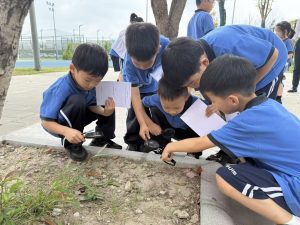
Grade 1 science starts with a simple yet magical act: looking closely.
“Look! There’s a tiny insect on this leaf!”
“This patch of grass is wetter!”
With magnifying glasses in hand, children explored every corner of the campus, discovering that nature is full of clues waiting to be noticed, described, and questioned.
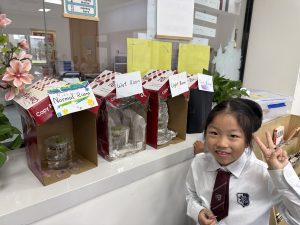
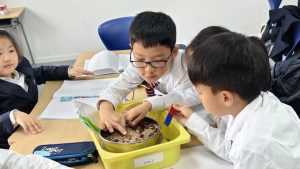
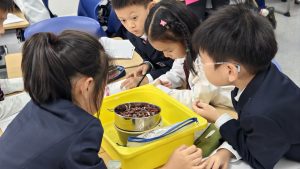
Back in class, observation turned into action. Students built four different “homes” for sprouting red beans—a Light House, Dark House, Water House, and Control House—to explore how environment affects plant growth.
A week later, their “findings” were met with excitement:
- Plants in the Light House were the strongest and greenest
- Plants in the Dark House turned yellow and thin
- Plants in the Water House grew more leaves
One insightful discovery made entirely by the students: all plants bent toward the light.
The teacher introduced phototropism, but the concept had already taken root in their observations.
In Grade 1, the true lesson isn’t plants, it’s learning how to observe the world.
Asking Why: Science Gives Meaning to Curiosity
Grade 2 – States of Matter, Reactions, and Dissolving Experiment
In Grade 2, children move from “I saw something happen” to “I want to understand why it happens.”
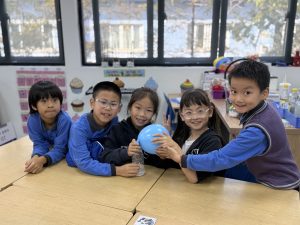
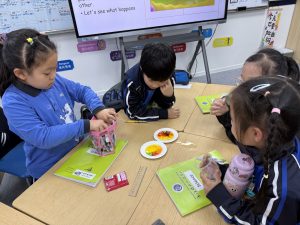
During the classic vinegar-and-baking-soda experiment, children watched bubbles surge upward and a flat balloon slowly inflate.
“Teacher, that’s gas!”
“They changed into something new!”
For the first time, they witnessed how a solid and liquid create a gas, not from a definition in the textbook, but from the evidence in front of them.
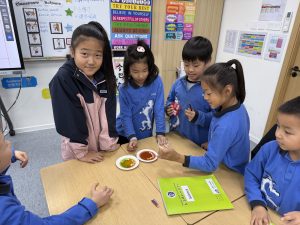
Next came the colorful dissolving experiment with candy in hot and cold water. Students discovered:
- Hot water dissolves faster
- Colors spread in circles, patterns, and waves
- Changing one variable changes the entire experiment
The classroom sounded like a tiny research lab: observing, comparing, recording, discussing.
In Grade 2, students begin using evidence to explain the phenomena they see.
They are not just doing experiments; they are learning how scientists think.

Creating with Purpose: When Science Becomes Innovation
Grade 3 – CREST SUPERSTAR Mechanical Hand Project
By Grade 3, science has expanded into a world of design, engineering, and problem-solving.
For their first CREST SUPERSTAR challenge, students explored how the human arm works—bones, muscles, tendons—before asking:
“How do robots copy human movements?”
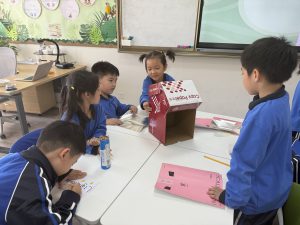
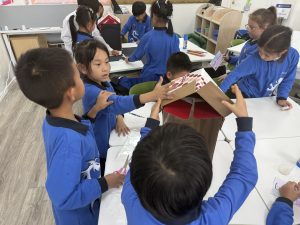
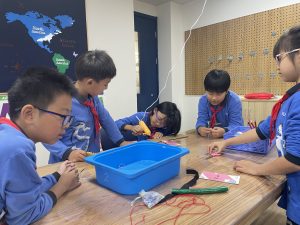
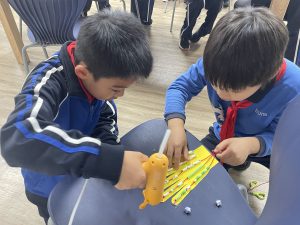
Then came the hands-on challenge: designing a mechanical hand using cardboard, straws, and strings.
Children cut, measured, tied, tested, adjusted, and tried again.
Problems arose—and so did solutions:
“The string is too tight!”
“The straw needs to be shorter!”
“It works better if we change the angle!”
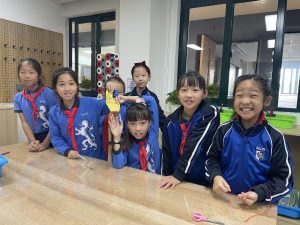
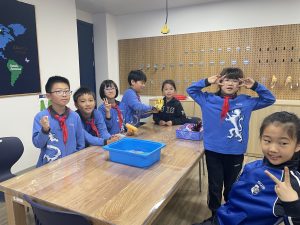
During presentations, each group proudly demonstrated their mechanical hands waving, counting, or gripping objects—and reflected on what worked, what didn’t, and why.
This is the heart of STEM learning:
design → test → revise → succeed.
In Grade 3, science becomes a tool for solving problems and creating something new.
Science Education at SUIS Pudong: A Journey of Thinking, Not Just Learning
Looking across the G1–G3 science curriculum, a clear progression emerges:
Grade 1: curiosity → observation
Grade 2: observation → explanation
Grade 3: explanation → innovation
Science grows with the child.
When students dare to ask questions, experiment with ideas, work with peers, and revisit challenges, they are developing not only scientific understanding but also the mindset of lifelong learners.
At SUIS Pudong, every science lesson is planting a seed:
a seed of curiosity, evidence-based thinking, creativity, and confidence,
that will continue to grow far beyond the classroom.