

Many parents remember the serious look on their child’s face the first time they memorized the multiplication table.
But at SUIS Pudong, the table is not an end—it’s a beginning.
It opens a door to logical thinking, everyday problem-solving, and, more importantly, a way for children to understand the world.
When math is taught with clarity, joy, and warmth, students don’t just get the answers right. They become curious, confident thinkers who dare to explore.
In this issue of Shine My Way, we visit a Grade 2 math class to discover how a lesson that seems simple on the surface can quietly shape the way a child sees the world.
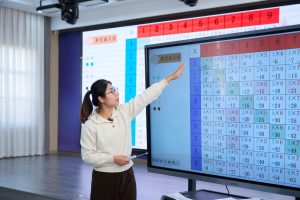
“What I want most is not just for students to get the answer right, but to be brave enough to think, and willing to explore. Sometimes, just looking at the multiplication table differently can spark a new way of thinking.”
— Rita Zhu, Primary Math Teacher
This is what Ms. Rita Zhu, one of our primary school math teachers, shared during a recent Pudong New Area open lesson event for Grade 2 mathematics, themed “Enhancing Engagement, Enriching Experience, and Developing Competency.” As the designated showcase teacher, Ms. Zhu conducted a demonstration class with a non-SUIS class, stepping into an unfamiliar classroom and still delivering a warm, thoughtful, and inspiring lesson. Her words reflect the quiet dedication and consistent belief that guide her daily teaching.
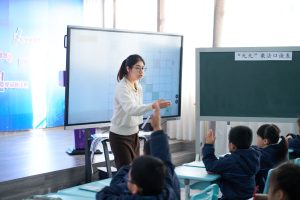
This quote from Ms. Rita Zhu came during a recent district-level open class. It’s also a reflection of her daily classroom commitment since joining SUIS Pudong in 2019: to make math not only rigorous, but heartwarming.
In her demonstration lesson on the “9×9 Multiplication Table,” Ms. Zhu designed an immersive experience centered around “pattern discovery.” Rather than starting with rules, she began with a question: “Does this multiplication chart look like a picture to you?”
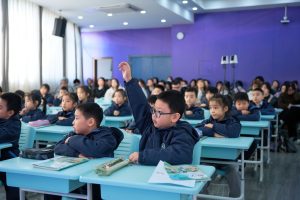
That one prompt set off a wave of student imagination:
“It looks like a ladder!”
“This side is the same!”
“There’s a pattern here!”
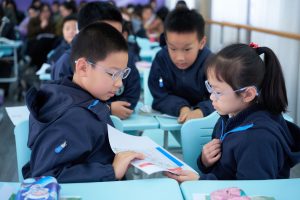
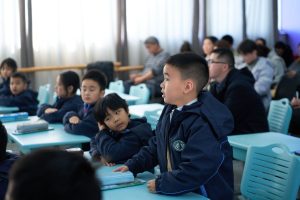
Guided by their observations, students began exploring mathematical structure through visuals, movement, and conversation—moving from image to idea, from curiosity to concept.
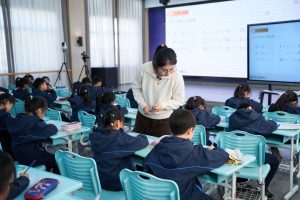
With hands-on puzzles, visual matching games, and guided “multiplication friend” challenges, students were encouraged to look beyond numbers and into relationships. Ms. Zhu even prepared differentiated tasks to support all learners, saying:
“Even with the same topic, children may process it in very different ways. I want them all to feel a sense of achievement in their own time and their own style.”
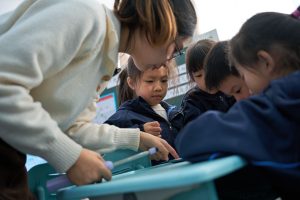
Beyond classroom teaching, Ms. Zhu actively participates in school-wide and regional professional development, and her students have achieved excellent results in competitions such as AMC. But for her, the most rewarding moment is when a child’s eyes light up with that quiet “I got it.”
At SUIS Pudong, teachers like Ms. Zhu are creating classrooms where every moment counts. Where students are not rushed, but invited. Not just taught, but inspired.
And it all starts—sometimes—with a simple multiplication table.